Pick your drink, size, milk and syrup pumps. This free Starbucks calorie calculator shows calories, sugar, protein, carbs, fat and caffeine for the exact order you place — plus a line-by-line breakdown of what is driving the total.

A Starbucks calorie calculator is a tool that estimates the calories and nutrition in a Starbucks drink after you customise it — your size, milk, syrup pumps, espresso shots and toppings — rather than quoting a single figure for the standard recipe.
Every control below changes the maths. Swap 2% for almondmilk and the milk line drops. Cut two syrup pumps and you watch the sugar fall. Nothing is a lookup table — the total is rebuilt from the ingredients each time.
Build your exact order and watch every number update as you go.
Estimates. Figures are modelled per ingredient and rounded. Stores vary and recipes change — check the official app before relying on a number for medical or dietary decisions. This site is not affiliated with Starbucks Corporation.
Most nutrition tools give you one number for one drink and stop there. That is not how anyone actually orders — you ask for oat milk, you drop a pump, you skip the whip, you size up because it is a Monday. Each change moves the number, and this tool is built around that.
Choosing a drink loads its standard build — the recipe you get if you order it without saying anything else. That figure is your baseline, and everything after is measured against it.
Switch the milk and leave everything else alone. The milk line moves while the base stays flat. That shows you which part of your order is actually expensive, and therefore worth changing.
The line-by-line list is sorted largest first. In most blended and flavoured drinks the espresso is irrelevant — the calories sit in the sauce, the cream and the milk. Seeing that ends the guesswork.
When there is an obvious saving the calculator offers it as a one-click swap, with the calorie difference stated up front. It only ever suggests the single highest-impact change.
Four things account for nearly all of it. Espresso contributes almost nothing — a shot is around five calories, and brewed coffee or unsweetened tea is effectively zero. If a drink is heavy, it is heavy because of what was added to the coffee, not the coffee itself.
Usually the single biggest line. A Grande latte holds around twelve ounces, so the milk choice moves the total more than anything else you can change.
Where the sugar hides. A Grande gets four pumps by default, a Venti five or six — so syrup alone can exceed a hundred calories before any milk.
Small decisions, large numbers. Whipped cream is around 80 calories of mostly fat, java chips around 90, and cold foam sits on top of a drink that is already sweetened.
A sweetened base that exists purely for texture — roughly 60 calories and 15 grams of sugar before any syrup, milk or topping is counted.
| Milk | Approx. cal / fl oz | In a Grande latte (~12 oz) |
|---|---|---|
| Whole | ~19 | ~225 |
| 2% (default) | ~15 | ~185 |
| Oat | ~15 | ~180 |
| Soy | ~13 | ~160 |
| Nonfat | ~11 | ~130 |
| Coconut | ~9 | ~110 |
| Almond | ~7.5 | ~90 |
The pattern worth remembering: almondmilk is the lightest common option and whole milk is roughly double it. Oat milk surprises people — it is popular and plant-based, but it sits close to 2% rather than close to almond, because it carries more carbohydrate. Worth knowing before you switch: most stores add a surcharge for non-dairy milk.
Sauces are heavier than syrups. Mocha sauce runs around thirty calories a pump and white chocolate mocha sauce around fifty-five — which is why a white mocha lands so much higher than a regular mocha built the same way. Sugar-free syrups are the one genuinely free swap: same flavour intensity, effectively zero calories.
Cold foam deserves its own mention, because it is added on top of a drink that is already sweetened. We broke the flavours down separately in our guide to Starbucks cold foam nutrition.
Reading about it is one thing. Put your usual drink into the Starbucks calorie calculator and watch the split for yourself.
Open the calculatorCalories are a blunt instrument. Two drinks at 250 calories can do completely different things to your day depending on where those calories come from — which is why protein, carbs, sugar, fat and caffeine all sit alongside the total rather than hidden behind it.
The number most people should watch. A single Grande flavoured latte can use most of a day's allowance, and a Venti Frappuccino can exceed it outright. It moves faster than anything else on the menu — and it is the easiest to reduce.
Comes almost entirely from milk — roughly one gram per fluid ounce of dairy. Switch to almondmilk and it collapses to about two grams. That is the trade-off almond drinkers rarely notice: ninety calories saved, ten grams of protein given up.
Does not track calories at all. A black cold brew is five calories and heavily caffeinated; a Vanilla Bean Crème Frappuccino is several hundred calories with no coffee whatsoever. If you manage caffeine, the calorie figure tells you nothing.
Outside of whipped cream, breve and whole milk, most drinks are fairly low in fat. If a drink shows a high fat number it is almost always the whip or a cream-based topping — and removing it is the fastest correction available.
Once you have used the calculator on a few drinks, the Starbucks menu organises itself into bands. Knowing roughly which band a drink sits in means you can order sensibly without opening anything at all.
Brewed coffee, Americano, cold brew, nitro, espresso shots, plain hot and iced tea. Effectively free in calorie terms — and this is also where the caffeine is most concentrated.
A Tall latte with nonfat or almondmilk, a cappuccino (mostly foam, so less milk than a latte of the same size), a misto, an unsweetened iced tea with a splash of milk.
Where most people actually live: a Grande latte, a flat white, a chai tea latte, a caramel macchiato, a matcha latte. Comfortably a snack's worth, and easy to move down with one swap.
Frappuccinos, white chocolate mochas, anything with whipped cream and drizzle, Venti flavoured drinks at full syrup. Nothing wrong with ordering them — just know they are closer to dessert than coffee.
Food changes the picture too. Pastries and loaves frequently outweigh the drink beside them — a slice of banana loaf sits around 380 calories on its own. Protein boxes and egg bites sit lower and carry far more protein, which makes them a genuinely different kind of choice rather than just a smaller one.
For the full board with current pricing, see our Starbucks menu prices guide. If you are shopping the lighter end specifically, we ranked the lowest calorie Starbucks drinks and the keto-friendly options.
Pairing coffee and protein has become one of the most common reasons people look up Starbucks nutrition at all — hitting a daily protein target, staying full until lunch, or making a coffee run do more than deliver caffeine.
| Build | Protein | Notes |
|---|---|---|
| Grande latte, nonfat | ~13 g | Most protein, fewest calories |
| Grande latte, 2% | ~12 g | The reliable default |
| Grande latte, soy | ~9 g | Best of the plant options |
| Grande latte, oat | ~5 g | Popular, but low in protein |
| Grande latte, almond | ~2 g | Lightest, barely any protein |
| Grande cold brew, black | 0 g | Caffeine only |
There is no protein in espresso. Every gram in a milk-based drink comes from the milk itself, so the two levers are how much milk the drink holds and which milk it is. We ranked the whole menu by protein-to-calorie ratio, and rounded up the best high-protein Starbucks drinks separately.
Model it directly: set the milk to nonfat, size up, and watch the protein figure climb while the calories barely move.
A calculator is only useful if it changes what you order. Here is how people actually get value out of one without turning every coffee into a spreadsheet exercise.
Most people order roughly the same thing most days. Model that one drink properly, find the version you are happy with, then stop calculating. One good decision applied daily beats a perfect decision applied occasionally.
For nearly everyone the biggest levers are milk and pump count. Half the syrup is barely noticeable in most flavoured drinks and removes a meaningful chunk of sugar. Switching milk is one word at the till.
Baristas build drinks in a fixed sequence, so orders land more accurately when you give size, then drink, then modifications. "Grande latte with almondmilk and two pumps of vanilla" beats the same information scattered through a sentence.
Tall to Venti is not a small change — it scales milk and syrup together. On a flavoured latte that step alone can add well over a hundred calories. Ordering a Venti with the Tall's pump count is an effective compromise.
The pastry beside your coffee is frequently the larger number of the two. If you are tracking seriously, the food deserves at least as much attention as the drink does.
Most tracking errors come from the same handful of assumptions — forgetting that size scales syrup, or reading a figure for a build you did not order. We listed the mistakes people make with a Starbucks calorie calculator, and how to read a Starbucks nutrition label properly.
Mostly — but not exactly. Any Starbucks calorie calculator works from standard recipes, and the gap between those and the cup in your hand is worth understanding before you treat a figure as precise.
Recipes, cup sizes and available milks are not identical worldwide. The Short and Trenta are not offered everywhere, and some regions use metric measures that do not map cleanly onto US ounce sizes.
Autumn and holiday drinks arrive with their own syrups, sauces and toppings, and they are often reformulated year to year. A seasonal figure from two years ago may simply no longer be correct.
Espresso drinks are made by people, not machines calibrated to the gram. Pours and pump counts vary a little between stores and shifts — small relative to the differences between drinks, but real.
For allergens, medical dietary requirements or anything clinical, the official Starbucks app and in-store information for your country are the correct reference. This is a planning and comparison tool.
Size is the single change that scales almost everything at once. It is not a fixed percentage — it moves milk, syrup and sometimes shots together.
| Size | Typical syrup pumps | Typical shots (latte) |
|---|---|---|
| Short | 2 | 1 |
| Tall | 3 | 1 |
| Grande | 4 | 2 |
| Venti (hot) | 5 | 2 |
| Venti (iced) | 6 | 3 |
| Trenta | — | — |
Two details catch people out. First, the iced Venti is larger than the hot Venti — 24 ounces against 20 — so it takes an extra pump and often an extra shot. Second, the Trenta is only available for cold drinks without milk, which is why it appears for cold brew and Refreshers but never for lattes.
The practical takeaway: sizing down one step is usually a bigger saving than any single ingredient swap, because it reduces several lines at once. Our full Starbucks size chart covers every cup in ounces and millilitres.
Counting calories, pricing an order, or recreating a drink in your own kitchen — start wherever it matters most to you.
Drink-by-drink calorie counts, size comparisons and the swaps that actually cut the number down.
Explore calories 2 guidesStep-by-step builds for the drinks worth making at home, with the ratios that get you closest.
Explore recipes 4 guidesSugar, carbs, protein and caffeine — how to read a label and what the numbers mean for your day.
Explore nutrition 1 guideWhat every size costs, how the menu is structured, and where the value actually sits.
Explore the menuNew breakdowns, brewing walkthroughs and menu explainers land here the moment they go live.
The 5 most common Starbucks calorie calculator mistakes, from wrong venti sizing to missed cold foam, and how…
Read the guide
Quick Answer Standard Starbucks cold foam (nonfat) adds about 35 calories to a Grande. Sweet cream cold foam…
Read the guide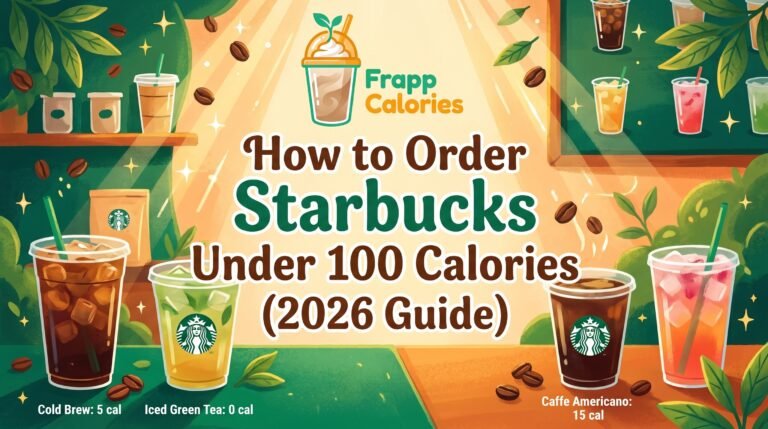
Quick Answer To order Starbucks under 100 calories, start with a low-calorie base (brewed coffee, Americano, cold brew,…
Read the guide
Quick Answer A Starbucks Matcha Latte (Grande) has 240 calories with 2% milk, 170 calories with almond milk,…
Read the guide
Quick Answer The Starbucks Medicine Ball (officially Honey Citrus Mint Tea) contains 130 calories in a Grande, 100…
Read the guide
Starbucks Pumpkin Spice Latte calories are one of the most searched nutrition questions every fall — and for…
Read the guideNutrition content is only useful if you can see where it came from. Here is the process behind every figure this tool produces.
Values are stored per ingredient — per fluid ounce of each milk, per syrup pump, per topping. A drink's total is assembled from those parts, so any swap recalculates honestly instead of falling back to a fixed number.
Each drink carries the recipe you get by default — its milk volume, pump count and shot count per size. That is the baseline every customisation is measured against.
The line-by-line breakdown exists so you can check the result rather than take it on faith. If a number looks wrong, you can see exactly which component produced it.
Nothing here is presented as an official figure. Menus change, stores vary and recipes are reformulated, so every number is marked as an estimate and the official source is named.
It is accurate enough to compare drinks and understand which ingredient is driving a total, which is what most people need. It is not a substitute for official figures.
Values are modelled from per-ingredient estimates and rounded, so expect results to land close to official numbers rather than matching them exactly. For allergen or medical purposes, use the official Starbucks app for your country.
Plain brewed coffee, an Americano, cold brew and unsweetened iced tea are all effectively negligible — around five calories or fewer before anything is added.
If you want flavour without calories, sugar-free syrup in an Americano or cold brew is the cheapest way to get it.
Almondmilk is the lightest common option at roughly 7.5 calories per fluid ounce, followed by coconut milk and then nonfat dairy milk.
Worth knowing: almondmilk also has the least protein. If protein matters to you, nonfat dairy milk gives you the best protein-to-calorie ratio on the menu.
A standard flavoured syrup pump is around 20 calories and about 5 grams of sugar. Mocha sauce is around 30, and white chocolate mocha sauce around 55.
Sugar-free syrups are effectively zero calories, which makes them the single easiest swap available.
Not yet — the calculator currently models drinks, where customisation actually changes the maths. Food items are covered in the written guides instead.
Three common reasons: your region's menu differs, the drink is seasonal and has been reformulated, or the store poured slightly differently from the standard recipe.
Drinks are hand-built, so small variation between stores and shifts is normal and expected.
No. This is an independent resource with no affiliation to Starbucks Corporation. Starbucks and the Starbucks logo are trademarks of Starbucks Corporation.