
Quick Answer
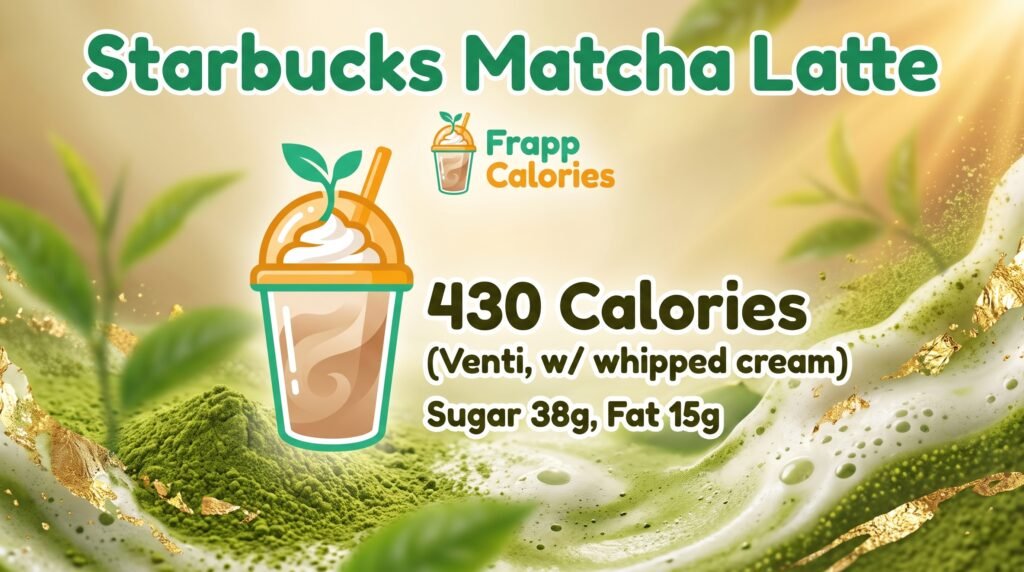
A Starbucks Matcha Latte (Grande) has 240 calories with 2% milk, 170 calories with almond milk, and 280 calories with whole milk. The Iced Matcha Latte (Grande) has 200 calories with 2% milk. All versions contain 80mg of caffeine and are pre-sweetened — the matcha powder blend already contains sugar and cannot be made completely unsweetened.
The Starbucks Matcha Latte is one of the most popular non-coffee drinks on the menu, but it surprises many customers with its calorie and sugar content. This guide covers exact calories for every size, every milk option, hot versus iced, and how the matcha latte stacks up nutritionally against other Starbucks drinks.
Starbucks Matcha Latte Calories by Size (2% Milk)
The standard Matcha Latte is made with 2% milk unless you request otherwise. Calories below use the default 2% milk recipe.
| Size | Hot Calories | Iced Calories | Sugar | Caffeine |
|---|---|---|---|---|
| Short (8 oz) | 130 cal | — | 19g | 55mg |
| Tall (12 oz) | 190 cal | 150 cal | 26g | 55mg |
| Grande (16 oz) | 240 cal | 200 cal | 32g | 80mg |
| Venti (20 oz hot / 24 oz iced) | 320 cal | 280 cal | 44g | 110mg |
The iced version is slightly lower in calories than the hot version because iced drinks use more ice and less milk per serving. For complete nutrition data across all sizes, see the official listings at starbucks.com/menu.
Starbucks Matcha Latte Calories by Milk Type (Grande)
Your milk choice has the biggest impact on the calorie count. Here is a complete breakdown for a Grande Matcha Latte across all milk options Starbucks offers:
| Milk Type | Hot Calories | Iced Calories | Fat | Sugar |
|---|---|---|---|---|
| Whole milk | 280 cal | 240 cal | 11g | 33g |
| 2% milk (default) | 240 cal | 200 cal | 7g | 32g |
| Nonfat milk | 190 cal | 160 cal | 1.5g | 33g |
| Oat milk | 240 cal | 210 cal | 5g | 36g |
| Soy milk | 250 cal | 210 cal | 7g | 33g |
| Coconut milk | 240 cal | 200 cal | 9g | 30g |
| Almond milk | 170 cal | 140 cal | 4g | 28g |
Lowest calorie milk option: Almond milk at 170 calories (hot) or 140 calories (iced). This saves 70 calories compared to the default 2% milk version. Use our Starbucks calorie calculator to see exact counts for your customized order.
Full Nutrition Facts — Matcha Latte Grande (2% Milk)
| Nutrient | Amount (Grande) | % Daily Value |
|---|---|---|
| Calories | 240 cal | — |
| Total Fat | 7g | 9% |
| Saturated Fat | 4.5g | 23% |
| Trans Fat | 0g | — |
| Cholesterol | 25mg | 8% |
| Sodium | 170mg | 7% |
| Total Carbohydrates | 34g | 12% |
| Dietary Fiber | 1g | 4% |
| Total Sugars | 32g | — |
| Added Sugars | 20g | 40% |
| Protein | 12g | 24% |
| Caffeine | 80mg | — |
| Calcium | 350mg | 25% |
What Is in the Starbucks Matcha Latte?
The Starbucks Matcha Latte has two ingredients: matcha tea blend and steamed milk. That is it — no espresso, no syrups, no sweeteners added separately.
The critical detail is the matcha tea blend. Starbucks does not use pure matcha powder. Their matcha blend lists ingredients as: sugar, ground Japanese green tea. Sugar is the first ingredient, meaning there is more sugar by weight than matcha in the blend. Two scoops go into a Grande, contributing the majority of the 20g of added sugar.
This means the Starbucks Matcha Latte cannot be made truly unsweetened. Reducing matcha scoops (from 2 to 1) reduces both the matcha flavor and the sugar simultaneously. Requesting “no sugar” or “unsweetened” does not change the blend used.
Can You Get the Starbucks Matcha Latte Unsweetened?
No — not completely. Because the sugar is baked into the matcha powder blend, there is no way to separate the matcha from the sugar using standard Starbucks ingredients. However, you can reduce sweetness by requesting fewer matcha scoops:
- 2 scoops (standard): Full sweetness, 32g sugar (Grande)
- 1 scoop: Roughly half the sweetness, ~20g sugar, and slightly fewer calories
- 1/2 scoop: Very mild flavor, minimal sweetness — some locations can accommodate this
If you want a truly unsweetened green tea drink at Starbucks, order plain brewed green tea (0 calories, 0 sugar) or a Jade Citrus Mint tea (0 calories) instead.
How to Reduce Calories in the Starbucks Matcha Latte
| Modification | Calories Saved | New Total (Grande, Hot) |
|---|---|---|
| Switch from 2% to almond milk | 70 cal | 170 cal |
| Switch from 2% to nonfat milk | 50 cal | 190 cal |
| Order iced instead of hot (2% milk) | 40 cal | 200 cal |
| Reduce to 1 matcha scoop | ~20 cal | ~220 cal |
| Almond milk + iced + 1 scoop | ~100 cal | ~140 cal |
| Almond milk + iced (standard scoops) | ~100 cal | ~140 cal |
The single most impactful swap is switching from 2% milk to almond milk — this saves 70 calories with no change to the matcha flavor. For the lowest-calorie matcha experience, order an iced Matcha Latte with almond milk and one scoop of matcha.
Starbucks Matcha Latte Caffeine
A Grande Starbucks Matcha Latte has 80mg of caffeine — consistent across both hot and iced versions (iced uses the same number of matcha scoops). Caffeine comes entirely from the matcha green tea powder; there is no espresso in a matcha latte.
This is moderate caffeine — more than a Grande green tea (25mg) but significantly less than a Grande drip coffee (310mg) or a double-shot Americano (150mg). For caffeine-sensitive individuals or afternoon consumption, the matcha latte is a softer alternative to coffee drinks.
Matcha Latte vs Other Starbucks Drinks
| Drink (Grande, default milk) | Calories | Sugar | Caffeine | Fat |
|---|---|---|---|---|
| Matcha Latte (2% milk) | 240 cal | 32g | 80mg | 7g |
| Matcha Latte (almond milk) | 170 cal | 28g | 80mg | 4g |
| Chai Tea Latte | 240 cal | 42g | 95mg | 4.5g |
| Flat White (whole milk) | 220 cal | 17g | 195mg | 11g |
| Vanilla Latte (2% milk) | 250 cal | 35g | 150mg | 6g |
| Caramel Macchiato (2% milk) | 250 cal | 33g | 150mg | 7g |
| Cold Brew (plain) | 5 cal | 0g | 205mg | 0g |
Compared to a Chai Tea Latte, the Matcha Latte has equal calories but less sugar and more protein. Compared to vanilla or caramel espresso drinks, the Matcha Latte has similar calories but substantially less caffeine. See our low calorie Starbucks drinks guide for more comparisons across the full menu.
Is the Starbucks Matcha Latte Healthy?
The Matcha Latte has a split nutritional profile — some genuine benefits and some significant concerns:
Benefits
- Matcha antioxidants (EGCG): Matcha contains epigallocatechin gallate, a powerful antioxidant linked to reduced inflammation and improved brain function. Even the blended Starbucks version retains meaningful amounts.
- L-theanine: Matcha’s unique amino acid promotes calm alertness — a cleaner focus than coffee without the spike-and-crash pattern.
- Protein and calcium: A Grande with 2% milk provides 12g of protein and 25% daily calcium — significant nutritional contributions.
- Moderate caffeine: 80mg is enough for alertness without the anxiety some people experience from high-caffeine coffee drinks.
Concerns
- High added sugar: 20g of added sugar in a Grande is 40% of the FDA’s daily recommended limit. This is the biggest drawback of the Starbucks Matcha Latte.
- Pre-sweetened blend: You cannot remove the sugar from the matcha powder, so there is a floor to how low-sugar this drink can get.
- Calorie density: At 240 calories, a Grande Matcha Latte is a substantial calorie investment for a beverage. It is not a low-calorie option by Starbucks standards.
Bottom line: The Matcha Latte offers real benefits from green tea antioxidants and dairy protein, but the pre-sweetened matcha blend makes it much higher in sugar than it appears. Ordering with almond milk and one matcha scoop brings it closer to a genuinely health-forward choice.
Matcha Latte for Specific Diets
Keto / Low-Carb
The standard Matcha Latte is not keto-compatible at 34g of carbs. The minimum you can get is approximately 20g of carbs (1 scoop matcha, almond milk) — still too high for strict keto. For a keto-friendly green tea option, order plain unsweetened green tea with a splash of heavy cream.
Intermittent Fasting
All versions of the Matcha Latte break intermittent fasting due to the milk and sugar content. A standard Grande (240 cal) is far above the 50-calorie fasting threshold. For a fasting window, switch to plain unsweetened green tea (0 calories).
Vegan
Order with oat milk, almond milk, soy milk, or coconut milk to make the Matcha Latte fully vegan. All plant-based milk options at Starbucks are dairy-free. Oat milk (240 cal) and almond milk (170 cal) are the most popular vegan choices.
Diabetic / Low-Sugar
The minimum sugar in any version of the Matcha Latte is approximately 20g (1 scoop matcha, almond milk). For diabetic considerations, this is still a relatively high-sugar drink. A plain brewed green tea is the better choice for blood glucose management.
Iced Matcha Latte — Full Guide
The Iced Matcha Latte follows the same recipe as the hot version — matcha blend whisked into milk — but served over ice. Key differences:
- Calories are 20 to 40 lower than the hot version per size because more of the cup is filled with ice.
- The matcha powder is whisked into a small amount of water first, then poured over ice and milk, creating a visually distinctive layered look.
- Customization is identical to the hot version — all milk options and scoop counts apply.
- The Iced version with almond milk (140 cal Grande) is the lowest-calorie full-flavor matcha option on the menu.
For a complete look at which Starbucks drinks are lowest in sugar and calories, see our sugar-free Starbucks drinks guide.
Frequently Asked Questions
How many calories are in a Starbucks Matcha Latte?
A Grande Starbucks Matcha Latte has 240 calories with 2% milk (the default), 170 calories with almond milk, 280 calories with whole milk, and 190 calories with nonfat milk.
Can you get a Starbucks Matcha Latte unsweetened?
No — not completely. The Starbucks matcha powder blend contains sugar as the first ingredient, so all versions have a baseline sweetness. You can reduce sweetness by requesting one scoop instead of two, but the drink cannot be made completely sugar-free.
How many calories is an Iced Matcha Latte at Starbucks?
An Iced Matcha Latte Grande has 200 calories with 2% milk, 140 calories with almond milk, 240 calories with whole milk, and 160 calories with nonfat milk.
How much caffeine is in the Starbucks Matcha Latte?
A Grande Matcha Latte has 80mg of caffeine. This comes entirely from the matcha green tea powder — there is no espresso in the drink. Both hot and iced versions have the same caffeine content.
What milk has the fewest calories in a Starbucks Matcha Latte?
Almond milk has the fewest calories — a Grande hot Matcha Latte with almond milk is 170 calories, compared to 240 with the default 2% milk. This saves 70 calories with no change to the matcha flavor.
Is the Starbucks Matcha Latte healthy?
It has genuine benefits: matcha antioxidants (EGCG), L-theanine for calm focus, 12g of protein, and 25% of daily calcium. The main concern is 20g of added sugar from the pre-sweetened matcha blend. Ordering with almond milk and one matcha scoop makes it a healthier option.
Is the Starbucks Matcha Latte vegan?
Not by default — it uses dairy milk. Order with oat milk, almond milk, soy milk, or coconut milk to make it fully vegan.
How many carbs are in the Starbucks Matcha Latte?
A Grande Matcha Latte with 2% milk has 34g of carbohydrates, of which 32g are sugars. With almond milk it has 28g of carbs.
What is the difference between a Matcha Latte and a Green Tea Latte at Starbucks?
They are the same drink. “Matcha Tea Latte” and “Green Tea Latte” both refer to the same Starbucks menu item made with matcha blend and steamed milk. The official name on the current menu is Matcha Tea Latte.
Does the Starbucks Matcha Latte have espresso?
No. The Matcha Latte contains no espresso and no coffee. Caffeine comes exclusively from the matcha green tea powder at approximately 80mg per Grande.