
The Starbucks nutrition label shows the calories, fat, sugar, protein, sodium, and caffeine for every drink on the menu — but reading it accurately requires knowing a few things the label itself does not explain. The number displayed reflects the standard recipe at the selected size, meaning default milk and default syrup pumps. Any customization you make changes the number, and toppings like cold foam are listed separately. This guide covers exactly what each field means, how to read it correctly by drink category, and the nutrition facts for specific Starbucks milks and frappuccinos.
Quick Answer: Reading a Starbucks Nutrition Label
- Where to find it: Starbucks app (real-time updates), starbucks.com/menu, in-store boards
- Serving size: The full drink as ordered — not a fraction of it
- What’s included: Standard milk, standard syrup pumps, standard toppings for that item
- What’s NOT included: Extra pumps, milk substitutions, add-on toppings you request
- Caffeine: Listed separately — note that light roasts have more caffeine than dark roasts
- Best tool for custom orders: Starbucks app customization screen or a calorie calculator
What a Starbucks Nutrition Label Shows — Field by Field
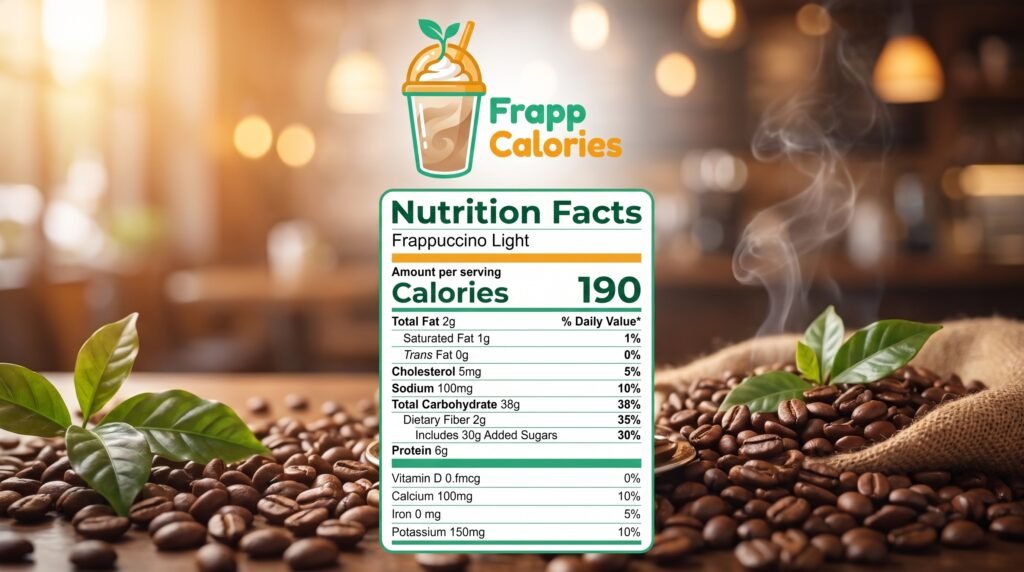
Every Starbucks nutrition label, whether on the app, website, or in-store board, shows the same seven fields. Here is what each one means and what to look for:
| Field | What It Means | What to Watch For |
|---|---|---|
| Calories | Total energy in the drink as prepared | Based on standard recipe — changes with milk swap or extra syrups |
| Total Fat | Includes saturated and unsaturated fat from milk, cream, and sauces | Whole milk and heavy cream add significant fat; almond milk is much lower |
| Sodium | Salt content — mostly from milk and some syrups | Usually low in black coffee, higher in lattes and blended drinks |
| Total Carbohydrates | Includes all carbs — fiber, starch, and sugar | Sugar is a subset of this number — do not add them together |
| Total Sugars | All sugar in the drink — from milk (lactose), syrups, and sauces | The most important number for diabetes and low-sugar diets |
| Protein | Protein from milk — espresso itself has almost no protein | Higher with more milk (lattes have more protein than black coffee) |
| Caffeine | Milligrams of caffeine per serving | Blonde roasts have MORE caffeine than dark roasts despite tasting milder |
The most common reading mistake is treating Total Sugars and Total Carbohydrates as separate additive numbers — they are not. Sugar is included within Total Carbohydrates. If a drink shows 50g carbohydrates and 45g sugar, the sugar is already counted in the carbohydrate total.
How to Read a Starbucks Nutrition Label — 5 Steps
Step 1: Confirm the Size First
Every nutrition label number changes based on size. The Starbucks app and website show a size selector above the nutrition panel — always confirm it matches your actual order before reading anything else. The difference between a Tall and a Venti can be 150 to 200 calories on a latte or Frappuccino. Hot Venti (20 oz) and Iced Venti (24 oz) are also different sizes with different numbers even though they share a name. See the Starbucks cup sizes guide for the exact ounce breakdown by size name.
Step 2: Check the Base Recipe Assumptions
The displayed nutrition label reflects the standard recipe for that drink and size — the default milk and the default number of syrup pumps. A Grande Caramel Macchiato label assumes 2% milk and 3 pumps vanilla syrup. If you ordered nonfat milk with 2 pumps, your actual drink has fewer calories than the label shows. If you added an extra pump or substituted oat milk, it has different calories. The label is a starting point for the standard build — not a guarantee for your custom order.
Step 3: Read the Core Numbers
For most tracking purposes, focus on four numbers: Calories, Total Sugars, Total Fat, and Caffeine. These tell you the most about the drink’s impact. Protein is useful for anyone tracking macros. Sodium is relevant mainly for people managing cardiovascular health or sodium-restricted diets — Starbucks drinks are generally low in sodium except for a few sauce-heavy options.
Step 4: Add Customizations Separately
Toppings, cold foam, extra drizzle, and add-on syrups are listed as separate items in the Starbucks nutrition system — they are not automatically included in the base drink’s label unless that topping is part of the standard recipe. If you added vanilla sweet cream cold foam to a drink that normally comes without it, those calories are not in the base number. The Starbucks app’s customize screen handles this automatically — as you add each topping, the calorie count updates. Manual label reading for complex orders requires looking up each add-on separately.
Step 5: Use the Calculator for Complex Orders
For any order with more than one or two modifications, manually tracking multiple label lookups gets error-prone. The Starbucks calorie calculator handles multi-step customizations as a single calculation, showing all six nutrition fields for your exact build. The Starbucks app’s in-order customization screen does the same thing and is the most accurate tool for real-time ordering decisions.
Starbucks Nutrition Labels by Drink Category
The following tables show nutrition label data for the most popular Starbucks drinks at Grande size with the standard recipe (2% milk where applicable). These are the numbers you would see on the official Starbucks nutrition label for each item.
Hot Espresso Drinks — Grande, 2% Milk, Standard Recipe
| Drink | Calories | Fat | Sugar | Protein | Caffeine |
|---|---|---|---|---|---|
| Caffè Latte | 190 cal | 7g | 18g | 13g | 150 mg |
| Cappuccino | 140 cal | 5g | 14g | 10g | 150 mg |
| Caramel Macchiato | 250 cal | 7g | 33g | 10g | 150 mg |
| White Chocolate Mocha | 430 cal | 12g | 54g | 14g | 150 mg |
| Pumpkin Spice Latte (seasonal) | 380 cal | 14g | 50g | 14g | 150 mg |
| Flat White | 220 cal | 11g | 17g | 12g | 195 mg |
Iced Drinks — Grande, 2% Milk, Standard Recipe
| Drink | Calories | Fat | Sugar | Protein | Caffeine |
|---|---|---|---|---|---|
| Iced Caffè Latte | 130 cal | 4.5g | 11g | 9g | 150 mg |
| Iced Caramel Macchiato | 250 cal | 7g | 33g | 10g | 150 mg |
| Iced White Chocolate Mocha | 420 cal | 12g | 54g | 12g | 150 mg |
| Vanilla Sweet Cream Cold Brew | 200 cal | 11g | 14g | 2g | 275 mg |
| Brown Sugar Oatmilk Shaken Espresso | 210 cal | 4.5g | 26g | 3g | 255 mg |
| Iced Blonde Vanilla Latte | 220 cal | 7g | 28g | 9g | 170 mg |
Starbucks Frappuccino Nutrition Label — Full Breakdown
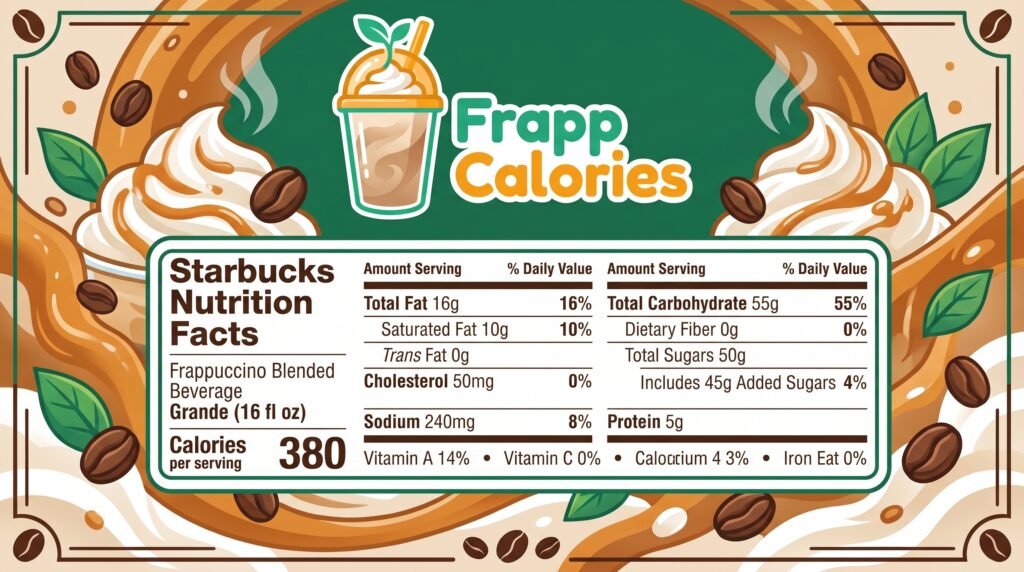
Starbucks Frappuccino nutrition labels differ from other drink categories in one important way: the base is whole milk by default (not 2%), and the blended Frappuccino base itself adds calories beyond what the milk and syrups contribute. Understanding this helps explain why Frappuccinos consistently show higher calorie counts than their latte equivalents.
| Frappuccino | Calories | Fat | Total Sugar | Protein | Caffeine |
|---|---|---|---|---|---|
| Caramel Frappuccino (Grande, whole milk, whipped cream) | 380 cal | 14g | 54g | 5g | 90 mg |
| Mocha Frappuccino (Grande, whole milk, whipped cream) | 370 cal | 14g | 52g | 5g | 95 mg |
| Java Chip Frappuccino (Grande, whole milk, whipped cream) | 440 cal | 18g | 57g | 6g | 105 mg |
| Vanilla Bean Crème Frappuccino (Grande, whole milk, whipped cream) | 400 cal | 15g | 60g | 5g | 0 mg |
| Matcha Crème Frappuccino (Grande, whole milk, whipped cream) | 420 cal | 15g | 61g | 6g | 70 mg |
| Strawberry Crème Frappuccino (Grande, whole milk, whipped cream) | 370 cal | 15g | 51g | 5g | 0 mg |
The Frappuccino nutrition label always assumes whipped cream in the standard build unless noted as “no whip.” Removing whipped cream saves approximately 100 calories per Grande and reduces fat by 9 to 10 grams. Switching from whole milk to 2% milk on a Frappuccino saves approximately 30 calories per Grande; switching to oat milk saves approximately 10 calories (oat milk is calorie-dense relative to 2%).
Starbucks Almond Milk Nutrition Label
Starbucks uses a shelf-stable, barista-formulated almond milk blend that differs slightly from retail almond milk cartons. When you see the nutrition label for any Starbucks drink made with almond milk, here is exactly what the almond milk itself contributes per serving:
| Starbucks Almond Milk | Per 8 fl oz (Grande latte base) |
|---|---|
| Calories | ~40 cal |
| Total Fat | 3 g |
| Saturated Fat | 0 g |
| Total Carbohydrates | 3 g |
| Total Sugars | 0 g |
| Protein | 1 g |
| Sodium | 150 mg |
The most important thing about the Starbucks almond milk nutrition label is that it contains no sugar — unlike oat milk, which has added sugar from the oat base. This makes almond milk the lowest-sugar non-dairy option at Starbucks. The calorie difference between almond milk and 2% milk in a Grande latte is approximately 60 to 80 calories — almond milk lattes consistently come in lower.
Almond Milk vs Other Milks — Starbucks Nutrition Comparison
| Milk Type | Calories (per latte serving) | Sugar | Fat | Best For |
|---|---|---|---|---|
| Whole Milk | ~190 cal (Grande latte) | 18g | 7g | Richest texture, highest calories |
| 2% Reduced Fat Milk | ~190 cal (Grande latte) | 18g | 7g | Standard default — similar to whole milk at Starbucks |
| Nonfat Milk | ~130 cal (Grande latte) | 19g | 0g | Lowest fat, still has milk sugar |
| Almond Milk | ~130 cal (Grande latte) | 0g added | 3g | Zero added sugar, low fat |
| Oat Milk | ~170 cal (Grande latte) | 7g added | 3g | Creamiest non-dairy, has natural sugars |
| Coconut Milk | ~160 cal (Grande latte) | 3g | 7g | Dairy-free with mild coconut flavor |
| Soy Milk | ~150 cal (Grande latte) | 18g | 4g | Highest protein non-dairy option |
The label difference between almond milk and 2% milk in a customized Starbucks drink is meaningful: switching from the default 2% to almond milk on a Grande latte saves approximately 60 calories and eliminates the added sugar from the milk itself, since almond milk has no natural milk sugars. For calorie-counting or low-sugar diets, almond milk is the most effective milk substitution.
Starbucks Coconut Milk Nutrition Label
Starbucks uses a coconut milk blend designed for hot steaming and cold applications. The coconut milk nutrition label at Starbucks shows the following per Grande latte serving:
| Starbucks Coconut Milk | Per 8 fl oz (Grande latte base) |
|---|---|
| Calories | ~80 cal |
| Total Fat | 7 g |
| Saturated Fat | 6 g |
| Total Carbohydrates | 6 g |
| Total Sugars | 3 g |
| Protein | 0 g |
| Sodium | 10 mg |
The most notable thing about the Starbucks coconut milk nutrition label compared to almond milk: coconut milk is higher in fat (7g vs 3g per serving) and has more calories than almond milk, though it is still lower in calories than whole or 2% milk. The fat in coconut milk is primarily saturated fat — worth knowing if saturated fat is a concern in your diet. Coconut milk has a mild, slightly sweet flavor that pairs well with Refresher drinks and iced coffees but can be noticeable in hot espresso drinks.
Starbucks Bottled Frappuccino Nutrition Label
Starbucks bottled Frappuccinos (the ready-to-drink bottles sold in grocery stores, gas stations, and convenience stores) have a different nutrition label than the in-store blended Frappuccinos. They are made by PepsiCo under a licensing agreement and use a different formula — lower in calories and fat than the in-store version but higher in caffeine per fluid ounce due to the smaller serving size.
| Starbucks Bottled Frappuccino | Per Bottle (13.7 fl oz) |
|---|---|
| Mocha | 190 cal, 3g fat, 31g sugar, 6g protein, 130mg caffeine |
| Vanilla | 200 cal, 2.5g fat, 32g sugar, 6g protein, 130mg caffeine |
| Coffee | 180 cal, 3g fat, 28g sugar, 6g protein, 130mg caffeine |
| Caramel | 200 cal, 3g fat, 33g sugar, 6g protein, 130mg caffeine |
| White Chocolate Mocha | 230 cal, 4g fat, 37g sugar, 6g protein, 130mg caffeine |
Key differences between the bottled Frappuccino nutrition label and the in-store label: the bottled version has significantly fewer calories (190 to 230 cal vs 370 to 440 cal for a comparable Grande) because it contains much less cream and no whipped topping. However, the sugar content per ounce is actually comparable — a 13.7 oz bottle at 31g sugar versus a Grande in-store Frappuccino at 52 to 60g sugar. The bottled version also uses whole milk as its dairy base in a different ratio than the in-store blended version.
Where to Find Official Starbucks Nutrition Labels
- Starbucks App: The most accurate and up-to-date source. Open the app, tap any menu item, scroll to “Nutrition.” The panel updates in real time as you adjust size, milk, and customizations — the only source that shows your exact custom order’s nutrition before you buy. Available on iOS and Android.
- Starbucks Website: The Starbucks menu nutrition page lists nutrition for all standard menu items with size selectors. Does not update for custom orders the same way the app does.
- In-store menu boards: Physical stores display calorie counts on the menu board above the counter for each standard menu item, per FDA labeling requirements for chain restaurants. These show calories only — not the full nutrition panel.
- Nutritional databases: Sites like FatSecret, CalorieKing, and MyFitnessPal carry Starbucks nutrition data but may lag behind seasonal menu changes or use older formula data. The Starbucks app remains the primary source for current figures.
Common Mistakes When Reading Starbucks Nutrition Labels
- Confusing hot and iced Venti: Hot Venti is 20 oz; Iced Venti is 24 oz. The label numbers are different even though both are called “Venti.”
- Treating sugar as additional to carbohydrates: Sugar is a subset of total carbohydrates — they are not two separate numbers to add together.
- Assuming toppings are included: Cold foam, whipped cream, drizzle, and add-on toppings are listed separately from the base drink. If you added them, look them up separately and add to the base.
- Forgetting syrup pump count: Each pump of flavored syrup adds approximately 20 calories. If your order uses a different pump count than the default, your actual calories differ from the label.
- Assuming nonfat milk is always lowest calorie: Nonfat milk has no fat but still has dairy sugar (lactose). Almond milk has fewer total calories and zero added sugar — for calorie and sugar minimization, almond milk often beats nonfat.
- Assuming oat milk is low-calorie: Oat milk at Starbucks has more calories than almond milk and contains natural sugars from the oat base. It is not a low-calorie swap — it is a non-dairy option that is mid-range in calories.
How to Use the Nutrition Label to Lower Calories
The nutrition label and the Starbucks customization system make it possible to meaningfully reduce the calorie count of almost any drink by identifying the biggest contributors and making targeted swaps. Here are the highest-impact changes ranked by calorie savings:
| Modification | Approximate Calorie Saving | What You Give Up |
|---|---|---|
| Remove whipped cream | 70–110 cal saved | Texture and richness on top |
| Switch to almond milk (from 2% or whole) | 50–80 cal saved | Some creaminess; gain: zero added sugar |
| Reduce syrup pumps by 2 | ~40 cal saved | Some sweetness — often still balanced |
| Switch to sugar-free syrup (where available) | Up to 80 cal saved (4 pumps) | Slightly different sweetness profile |
| Switch to nonfat milk (from 2%) | 30–50 cal saved | Some richness; milk sugar stays |
| Remove drizzle/sauce topping | 20–30 cal saved | Visual presentation and a little flavor |
The biggest single savings come from removing whipped cream and switching milk type. Combining both changes — almond milk and no whip — can reduce a latte or Frappuccino by 120 to 180 calories without changing the core drink. For a full list of low-calorie drink recommendations using these principles, see the top 10 low-calorie Starbucks drinks guide.
Key Facts About the Starbucks Nutrition Label
- All Starbucks nutrition labels reflect the standard recipe — not your custom order
- The Starbucks app is the only tool that updates the label in real time as you customize
- Starbucks is required by FDA law to display calorie counts on in-store menu boards for all items
- Total sugars includes both natural sugars (from milk, fruit) and added sugars (from syrups)
- Almond milk has the lowest calories and zero added sugar of any Starbucks milk option
- Coconut milk has the most saturated fat of any non-dairy milk option at Starbucks
- Bottled Frappuccinos (grocery store) have different nutrition labels from in-store Frappuccinos — same name, different product
- Caffeine on light roast drinks is higher than dark roast, despite lighter flavor
- Seasonal drinks get new nutrition labels each season — always check the current year’s label
Starbucks Nutrition Label — FAQ
Where can I find the Starbucks nutrition label for my drink?
The Starbucks mobile app is the most accurate source — it shows the complete nutrition panel for any menu item and updates in real time as you customize size, milk, and add-ons. The Starbucks website also shows nutrition for standard recipes. For custom orders, use the Starbucks calorie calculator to see the exact total for each modification.
Does the Starbucks nutrition label include whipped cream?
For drinks that include whipped cream as part of the standard recipe (like a Frappuccino), yes — whipped cream is included in the label number. For drinks where you added whipped cream as a customization (it is not in the standard recipe), those calories are not in the base label and need to be added separately. Whipped cream adds approximately 70 to 110 calories per serving.
Do total sugars and total carbohydrates need to be added together?
No. Total sugars is a subset of total carbohydrates — it is already included within the carbohydrate number, not separate from it. Adding them together would double-count the sugar. If a drink shows 50g total carbohydrates and 45g total sugars, the 45g of sugar is already part of the 50g carbohydrate total.
Why is the nutrition label different for hot and iced Venti?
Hot Venti is 20 fluid ounces; Iced Venti is 24 fluid ounces. They are different sizes despite sharing the same name. The larger volume of the Iced Venti means more milk, more syrup, and more of every ingredient — so the nutrition label shows different (usually higher) numbers for the iced version at the same size name.
Is almond milk lower in calories than nonfat milk at Starbucks?
Yes, typically. Starbucks almond milk contributes approximately 40 calories per Grande latte serving with zero added sugar. Nonfat milk contributes approximately 60 to 70 calories per Grande latte serving with natural dairy sugar (lactose). For both calorie reduction and sugar reduction, almond milk is generally the better choice at Starbucks over nonfat dairy milk.
Is coconut milk lower in calories than regular milk at Starbucks?
Coconut milk (approximately 80 calories per Grande latte serving) is lower in calories than 2% or whole milk (approximately 100 to 130 calories per Grande latte serving) but higher in calories than almond milk (approximately 40 calories). Coconut milk also has significantly more saturated fat than any other Starbucks milk option at approximately 6g per serving.
Are the bottled Starbucks Frappuccinos lower in calories than in-store ones?
Yes. Starbucks bottled Frappuccinos (grocery store RTD bottles) range from 180 to 230 calories per 13.7 oz bottle. In-store blended Frappuccinos at Grande (16 oz) range from 370 to 440 calories. The bottled version contains much less cream and no whipped topping, making it significantly lower in both calories and fat despite a similar sugar load per ounce.
Does the Starbucks nutrition label change seasonally?
Yes. Seasonal items like the Pumpkin Spice Latte, Peppermint Mocha, and holiday drinks get new or updated nutrition labels each season they are available. Always check the current label in the app or on starbucks.com rather than relying on nutrition data from a previous year, as recipes can change between seasons.
How accurate is the Starbucks nutrition label?
The Starbucks nutrition label is accurate for the standard recipe but is an estimate with a typical variance of ±10% to 20% based on barista preparation, pump measurement precision, and ingredient batch variation. For most tracking purposes it is accurate enough. For medically critical dietary management (diabetes, allergies, clinical nutrition), always consult the official Starbucks nutrition data and speak with a healthcare provider.
How many calories does a syrup pump add to the nutrition label?
Each pump of standard Starbucks flavored syrup (vanilla, caramel, hazelnut, cinnamon dolce, etc.) adds approximately 20 calories and 5 grams of sugar. A Grande drink’s standard recipe uses 3 pumps — if you add one extra pump, add 20 calories to the label number. Sugar-free syrups add 0 calories per pump.
More Starbucks Nutrition Deep-Dives
If you want these principles applied to specific coffees, our breakdown of Starbucks Veranda Blend calories covers the blonde roast in detail, while the Starbucks Pike Place Roast calories guide does the same for the signature medium roast. When you are comparing what each drink costs, the Starbucks menu prices guide lays out current pricing across the menu.